When I first visited Montana in April 2025, I was completely awe-struck. The sheer number of hills, mountains, and ridgelines made me wonder: how did early settlers and Native Americans navigate and maintain a sense of position without anything like GPS?
Pretty quickly, I realized the answer starts with learning the “language of the land.” Every place has a distinctive shape, especially its skyline. So I began paying close attention to ridgelines and started recording video and taking photos of nearly every skyline I saw.
What surprised me was how fast it started to work. On later visits, I could often place myself in a general area just by looking at the outline of the terrain. Call it intuition or pattern recognition, but it became reliable enough that it made me appreciate how skilled local knowledge must have been long before modern navigation tools.
That context is what made a moment in Gold & Greed hit me so hard.
The “wait… what?” moment in Episode 3
While rewatching the series (again), I noticed something subtle that instantly felt wrong. One of those “WTF” details that you don’t see right away but you feel something is off.
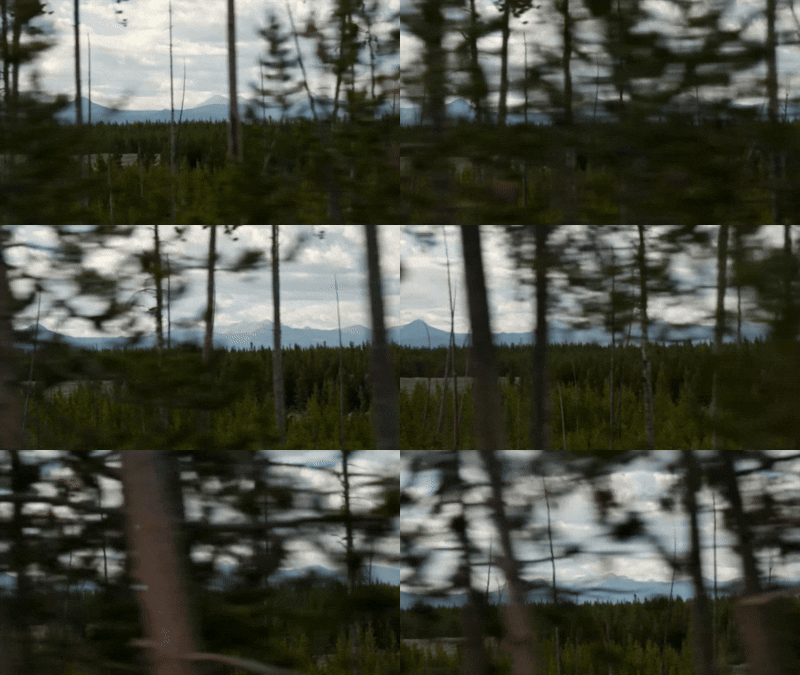
In Episode 3, around the 27-minute mark, there’s a very short shot (about 3 seconds) that’s easy to dismiss as normal b-roll because it blends into the pacing of the scene. But when I froze it and compared it to how the terrain should read, it clicked:
The shot appears to be flipped/mirrored.
In other words, the mountains are reversed left-to-right from how they would appear in reality.
I’ve turned that moment into a GIF by fixing the clip so it’s easier to see.
Why I think this matters
Justin mentioned at the Dillon, MT Q&A last year that there was a clue nobody had pointed out in the series. He said it was in Episode 2 or 3, and that it was a scene he wasn’t in, but one he had creative influence over.
Since then, people have picked apart the episodes pretty heavily, and I haven’t seen anyone publicly call out this specific detail.
That’s why this mirrored shot stands out to me as potentially intentional:
- It’s subtle enough to pass as ordinary b-roll.
- It disrupts the viewer’s pattern recognition (especially if you’re using terrain as a reference).
- It could also throw off automated scene matching or image-search-based approaches.
Could it just be editing convenience or “movie magic”? Absolutely. I can’t prove intent. But I can say it looks deliberately edited, and I somehow didn’t catch it until now.
Leave a Reply