Originally drafted in August 2025 while camped at Baker’s Hole Campground. It was updated as recently as the publishing date.
Eighteen days into my second BOTG and finally starting to feel like I did not need to spend every second of every day running around.
I had started compiling my thoughts on the checkpoint. More specifically, I was starting to wonder about the architecture of the hunt itself. That is where the foundation of The Second Map Theory began to form. Things were lining up for me, but the idea still needed to be polished, organized, and completed.
In this post, I try to explain the theory in the way I think it deserves.
The Mirage of the Finish Line
Imagine being boots on the ground after months of chasing theories. You have worked through what feels like your hundredth solve. Then, finally, you are standing in a place that feels different.
Until now, this spot has only existed on your screen, in satellite imagery, old maps, articles, and late-night notes scattered across your desk. But now you are there. The air is real and the there is dirt on your boots. The landscape looks exactly the way you imagined it would, maybe even better. Every clue that brought you here feels solid. Every turn of logic seems to hold.
You look around, heart racing a little, and then you see it. The thing you came to find. You open it, expecting answers. Instead, you find another beginning. Not the treasure. Not the end. Just another set of clues pointing somewhere else.
This is the heart of what I call the Second Map Theory. The checkpoint may not be the end of the first phase. It may be the moment the searcher is granted access to the next one.
The Rabbit Hole
The basic idea is simple: what if the checkpoint serves as a confirmation that you are on the right track and at the same time, it is actually the start of a new hunt?
What if finding it does not mean you are standing near the treasure at all, but rather that you have earned access to a second map? Maybe context that is supported by the rest of the poem.
Parsing Justin’s Words
To understand the checkpoint, we have to look closely at the language Posey uses. Justin mentions at the Dillon Q&A that when someone finds the checkpoint, they will realize unequivocally without a doubt they know that they are correct.
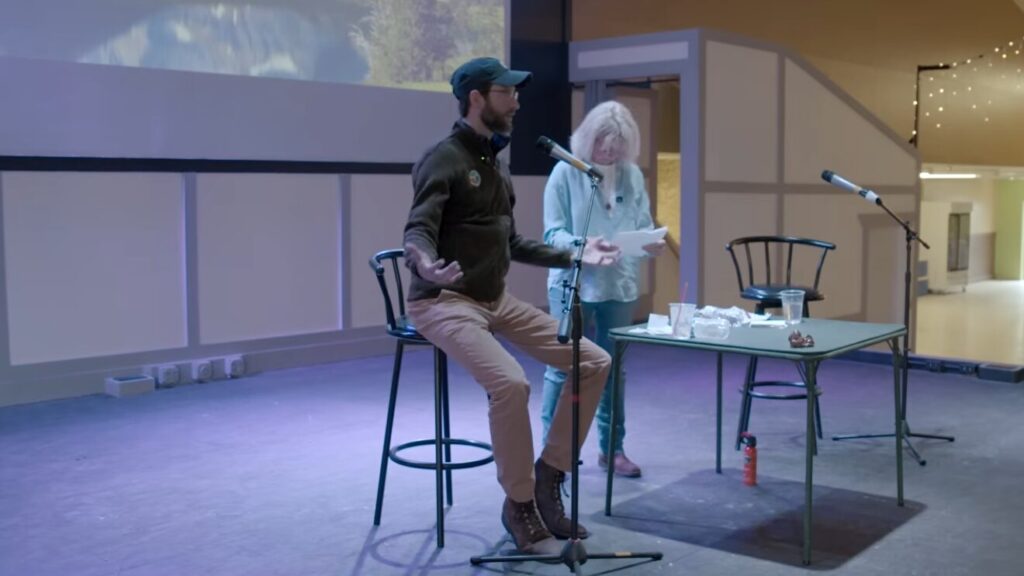
Source: https://youtu.be/u-1jcFpggC0?si=MFbF_MX_R3K5tEeX&t=1027
That is a bold thing to say. How can he be that certain?
He goes on to say that finding the checkpoint gives someone an excellent chance of finding the treasure.
An “excellent chance” is not the same thing as a guarantee.
If the checkpoint is unmistakable once found, but still does not guarantee the treasure in hand, then maybe it is a transition point. Maybe it is the moment where the hunt changes tactics.
Justin also mentions that the checkpoint is a “portion of the hunt“. This suggests that the checkpoint contains something of volume and not just a “Hey, Good Job – signed Justin M. Posey” note. While a note may be involved, there may be a new portion of the hunt revealed that is not as cut and dry as one may think.
Source: https://youtu.be/u-1jcFpggC0?si=924C4fmzZOkrNpdY&t=992
The last thing I want to point out is that Justin also said another reason he added the checkpoint was to “partially combat some of the AI concerns.” To me, this is probably the strongest evidence the checkpoint provides additional information or clues not publicly known or available yet.
Source: https://youtu.be/u-1jcFpggC0?si=0gpQhzS3pb1ij9rS&t=1028
If the checkpoint contains the rest of the hunt, there is no way that AI could access the information. I go into more detail later why and how LayerV is most likely involved at this point in the hunt.
In adventure stories, this structure is everywhere.
In National Treasure, one clue leads to another, and then another. The hunt is not solved by finding one object. It is solved by understanding how each new object, each new clue, and each inherited piece of knowledge connects to the next step.
In Indiana Jones and the Last Crusade, the Grail Diary does not simply hand Indiana Jones the Holy Grail. It serves as a guide, a filter, and a key. It gives him the information needed to continue the search.
In Beyond the Map’s Edge, Justin’s diary could very well be our Grail Diary. It contains his secrets, his past, and what led him there. Most importantly, it may contain a map that has been hand drawn by Posey himself.
It may not be the treasure, but it may point toward the next beginning. A hunt within the hunt. A poetic dose inception.
Visual Cues in Gold & Greed
There are visual details in Gold & Greed that keep pulling me back to this idea.
The Packages
In the show, there are packages on Justin’s desk that appear to be wrapped in brown paper and tied with twine. They have that old-school mailed-package look, the kind of thing that immediately feels intentional in an old treasure-hunt kind of way.
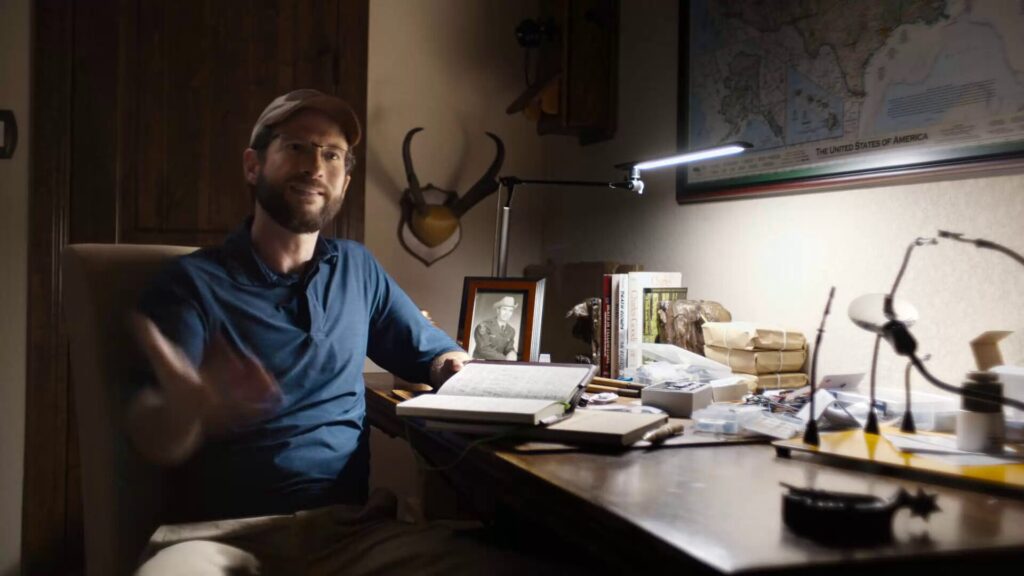
There is another scene from the series where the packages can be seen in another location but this time they have a magnifying glass on them.
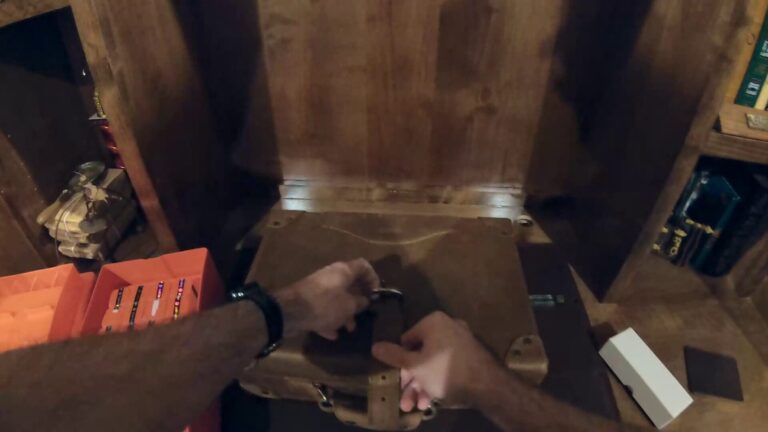
I do not know if the magnifying glass is meant as a clue, but visually, it does exactly what a clue would do. It suggests subtle language spoken in a visual manner saying “look closely at me“, or maybe even “look for me.” It truly has a Myst vibe.
Other than politely asking Justin to mail me the packages and monitoring my mailbox for something that will never come, I have to turn to what they could mean rather than what they were.
If these packages are intentional visual language, they may be reinforcing the idea of a delivered object, a contained message, or something that must be opened to continue.
This is were Indiana Jones comes into play.
In The Last Crusade, Henry Sr. mails Indiana his Grail Diary to keep it out Nazi hands. Indiana uses the contents of the diary to find one of three crusader brothers, scribes the engravings from his shield, and then uses the new information and a hand drawn map in his fathers diary to find the starting point and how to get to the location of the Holy Grail.
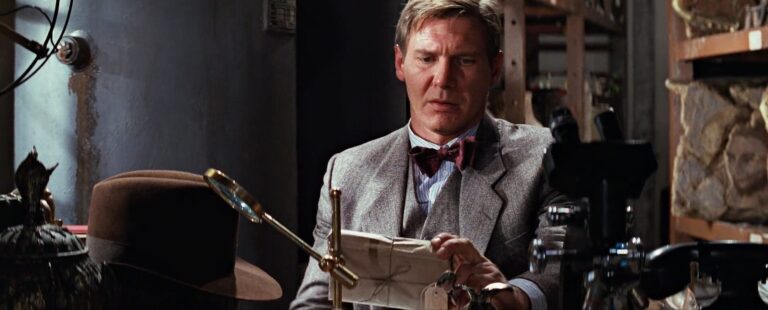
Frankly speaking, Indiana is known for using a diary to help him in his adventures. What makes it even better is that the diary’s were rarely his. The most prominent being the Ravenwood Diary and the Grail Diary.
Very rarely are all the clues and keys of a treasure hunt combined into a nice package when it comes to Hollywood. They are fragmented and the searcher is required to use what they have to find the next.
It really brings out the ring in the technical clue solution “The key to one direction lies within another.”
Source: https://treasure.quest/en/announcements/?page=3#title-oct-17-2025
Throughout the series, Justin is seen with his diary of notes. There are even cuts where you can briefly see some of the contents of the diary. While the notes revolve around the Fenn hunt, the diary should not be discredited.
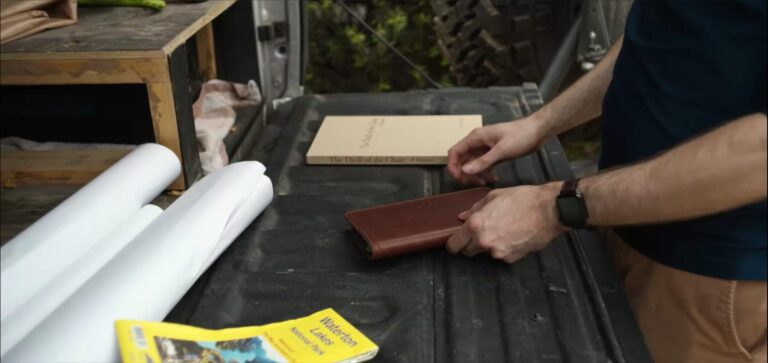
During the Seekers Summit Q&A, Justin mentions that the location of the treasure is near a place he had visited while he was hunting for Fenn’s treasure. This adds a lot of creditability to the idea that the location of the treasure could be narrowed down using the contents of Justin’s diary.
Let’s not forget the infamous “Where did I put that note?” quote during the Q&A at Seekers Summit.
Source: https://youtu.be/4cjpymh2LXc?si=h3rLKG0h2BtXHo_m&t=334
Clues in the Book
The Gracie Gail
The chapter “The Gracie Grail” adds another layer to this idea.
In that chapter, Justin finds an old hand-drawn map on the shelves and reflects on what guided the cartographer’s hand:
“When I unfold the map now, I understand what guided the cartographer’s trembling hand. The same force that filled Gracie’s shelves. The same fever that keeps me hunting: this desperate belief that we can somehow catch time in a net of collected things.”
What I personally take from it is that Justin understands the act of creating his own meaningful map. Not just a map that shows roads, rivers, or boundaries, but a map that carries memory, intention, obsession, and purpose.
The Design Problem
A Physical Diary
For a while, I liked the idea that the checkpoint could be a physical diary or journal. Something hidden in the spirit of Indiana Jones. Something that contains notes, maps, and a new set of instructions.
But the more I think about it, the more problems it creates.
If the checkpoint contains a physical diary, then the first person to find it could simply take it. That would effectively end entire hunt for everyone else.
Even worse, someone could find the checkpoint, remove the key information, fail to solve it, and leave the hunt permanently damaged for everyone who comes after them.
That does not feel like a clean design and definitely does not feel like Justin.
A physical object could still work, but only if it were fixed in place, impossible to remove, or somehow duplicated. Otherwise, it creates more problems than it solves.
This is where the theory starts to pivot.
The LayerV Connection
Justin has mentioned that his company, LayerV, has some bearing on the hunt.
Source: https://youtu.be/4cjpymh2LXc?si=Hl9IiEkZwKt2zuOd&t=2035
That does not automatically mean the checkpoint is digital, but it does make the possibility worth considering.
A digital checkpoint would solve several problems at once.
Imagine something fixed at the checkpoint: a QR code, a URL, or some other access method. The finder could use it to reach a protected page using a qURL, a hidden file, a digital diary, a second map, or a new set of clues.
- It would allow the checkpoint to be unmistakable. If you find the correct access point and it opens the correct resource, there would be absolutely no doubt.
- It would allow more than one searcher to find the checkpoint without the first finder physically removing it.
- It would allow Justin to know the checkpoint had been found.
- And most importantly, it would explain why finding the checkpoint gives someone an excellent chance of finding the treasure without guaranteeing success.
The checkpoint would be the doorway. A save point in the hunt with new levels unlocked. Protected by LayerV and a qURL.
If you have not figured out by now, Justin really wants us to go to https://layerv.ai/. At first, I asked myself why Justin would be spamming everyone with the same thing over and over again? Especially if 98 percent of the searchers do not understand the technical details behind LayerV’s technology to begin with.
It dawned on me later that maybe he is trying to make sure that searchers, at the very least recognize the name. There may come a time when a searcher has to interact with a qURL or LayerV. A searcher may pass it off as an untrusted source if they are not aware.
Conclusion
Whether or not the checkpoint leads to a new level is still TBD. What I can say is this: even if this theory holds up, the checkpoint still has to be reached. And as of the time I am completing this post, 10:21 PM ET on July 7, 2026, the treasure is still out there.
Excellent. I too believe the packages are a big clue. Look for three things stacked. Or, are they parcels? Three parcels you cross? I’m leaning towards three things stacked. The magnifying glass is saying “Look here!”
I now think the checkpoint is either a QR code or a data stick. A QR could be painted over by a finder though. So maybe when you find the checkpoint it’s simply a congratulations message letting you know the coordinates of the treasure location, in some pretty isolated spot where no one would be looking.
But then again…the problem with a QR code is any hobo with a phone could scan it. Justin probably has a fix for that. I do agree the solve has you moving to different locations like in National Treasure.
Love your posts!
Thank you for the comment and reading!
About your comment regarding the QR code and anyone being able to scan it. You are very correct in that sense. I like to think that if that is the route (and it is a big if), the tactic would not provide coordinates. I actually think it may be a second map that makes little or no sense to anyone not part of the hunt.
Going back to the Indiana Jones part of this and the Last Crusade, Indiana had a map, knew what it was for, and yet it did nothing for him until he uncovered the starting location. Making the assumption that Justin is providing additional information at the checkpoint (whatever it may be), it would be in reverse. We have the starting point or will know it already when needed and the map would attempt to tie it together. Without being part of the hunt, one could scan or for find it and disregard it as noise in a busy world.
I thought maybe he would use coordinates at one point but it goes against what he said at the Dillon Q&A about the checkpoint. If someone is given coordinates, they would for sure be able to find the treasure. He says they would have an excellent chance, suggesting there will me more clues to solve.
How cool would it be to have a map that you find along the way!?
Justin, I find your posts very informative. You clearly know your stuff! Here, you consider the possibility that the checkpoint could be (or partially be) in digital form – in that it may transmit the starting location of a “second map” to the finder via a QR code or unique qURL. While I personally find it unlikely that a QR code is used at the checkpoint stage, I agree that some form of digital relay of information is likely in play here.
Thus, what are your thoughts with respect to the possible use of a QR code, or reverse infrared QR code at the final treasure location? In one of your earlier posts you discuss capturing infrared light (possibly being emitted from cameras or the treasure container itself) using a basic cell phone camera as a “sniffer.” Is it possible that such infrared light is also transmitting data? If so, what sort of app or lens filter would be required to capture that data? I pose this question since you appear to have extensive experience in this field, and my gut tells me we’re going to be required to scan something at some point (to either legally confirm the find or be directed to another location). Thanks in advance for any insights you might provide.
Hi Tom,
Thanks for the comment. I maintain an open mind when it comes to anything. I try not to box myself in with specifics when it comes to things I actually take seriously (not that I don’t take my own therory serious, but it is just a theory). With this said, I am open to a QR code, but it does fall victim to the same concerns as a physical diary. It can be tampered with.
After talking with some folks about this theory a bit more, I see another possibility being in play. A true access point in the real digital sense. A WiFi signal is one of these possibilities. Connecting to it would be something everyone would know how to do. Once connected, a captive portal is deployed. Beware, I am just spitballing here, but that is just one of the possibilities.
I am not sold on the IR idea. Too much special equipment is required, and there is too much of a chance that a valid searcher just doesn’t have the tool. On the safety page at https://treasure.quest/en/safety/, Justin mentions downloading offline maps. Knowing that most people will have a cell phone, think of things that one could use without downloading special apps. These are some of the possibilities I am thinking of.
Camera/scanner, wifi/ble modules, etc.
Everything is still in play here for me but I try to ensure I remember and know all the possibilities before heading BOTG. I never depend on any assumptions.
Happy Hunting
Yea, use of a hidden WiFi signal would make perfect sense in a remote area. I’ll be on the lookout for that potential connection. Unfortunately, coming off the July 4th holiday I’ve been wrestling with Expedia to find a reasonably priced flight back into my targeted search area in Montana. I’d undertake the drive – but coming from San Diego, it would be roughly 50 hours roundtrip for me to check out a new theory and a single spot. But definitely eager to get back out there soon. Thanks for your insights.