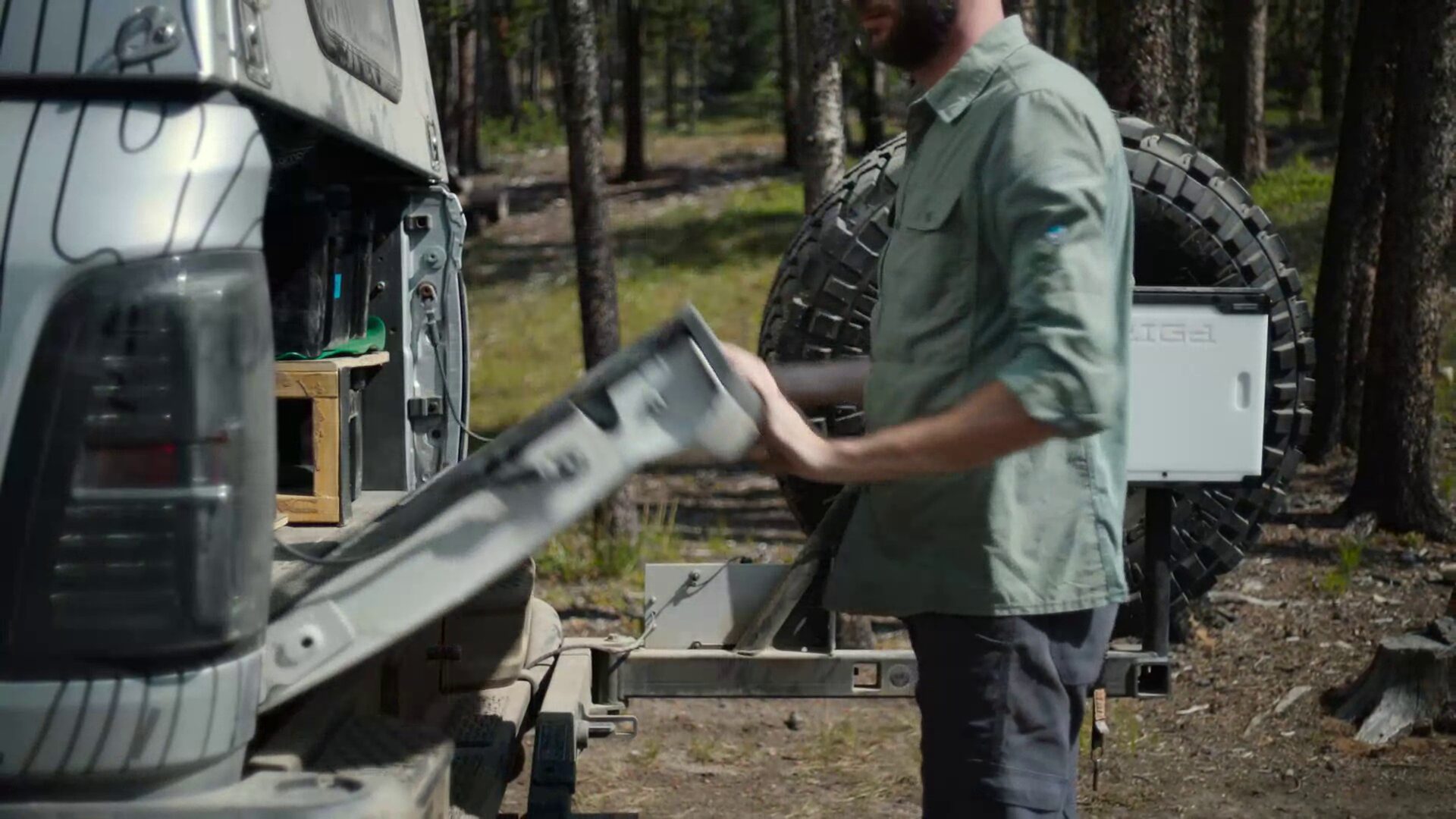
The number 42 has its place in the Beyond the Map’s Edge treasure hunt. It is marked on the taillight of Justin’s truck in a scene from Gold & Greed, and it is one of the numbers that are clearly identified and appears to serve a purpose. It is a number with little to no doubt it belongs. It represents something.
The question is what.
Theories in the hunting community tend to revolve heavily around rainbows and the meaning of life. While I do subscribe to both the rainbow theory and the meaning-of-life theory, I keep them on the lowest paid plan with ads.
Before continuing to read on, understand this post is more of a nerd dive into something that I am over analyzing on purpose. My intention is not poke holes and be the guy that argues over semantics. I want to address something that may or may not have a connection to the scene in the show where Justin is explaining x-ray vision (spoiler alert).
Continuing, I want to talk a bit about the number 42 and rainbows, because I love the idea of a rainbow connection. But I also think the 42-degree idea may be applied too broadly and can be misleading, even if it still points in a similar direction.
For a deeper precursor, I highly recommend watching What They (Probably) Don’t Teach You About Rainbows At School. It was a great primer to understanding the whole concept a little better. If anything, you can sound like the smart friend while on a hike using what many would consider useless knowledge. Unless you use it to find a treasure, then you will be a genius.
A primary rainbow forms through sunlight entering water droplets, refracting, reflecting once inside the droplet, and then refracting again as it exits. Because different wavelengths of light bend by slightly different amounts, the colors emerge at slightly different viewing angles. Red light appears near the outer edge of a primary rainbow at roughly 42 degrees from the antisolar point.
As the angle increases or decreases, eventually light enters a spectrum where there is still color, but our human eyes can not see it. If you could, you would essentially have X-ray vision or potentially be having the most intense hallucination, rivalling only your college days. In other words, 42 degrees is not the whole rainbow. It is closer to the red edge of the primary rainbow.
The rainbow itself is a continuous spectrum. There are no hard borders between red, orange, yellow, green, cyan, blue, and violet. Those are human categories placed onto a smooth gradient of visible light. The colors blend into one another, even though our eyes and brains tend to divide them into separate bands.
That distinction matters. Saying “a rainbow is 42 degrees” is not exactly wrong in casual conversation, but it is incomplete. More precisely, the primary rainbow occupies a small range of angles, with red appearing near 42 degrees. Take a look at the captions of many infographics that show a rainbow with a single angle, and you will usually find some kind of asterisk. The authors are often oversimplifying the geometry for the sake of explanation.
So if 42 is being used as a clue, it may not simply mean “rainbow.” It may point more specifically toward the color red. Move slightly beyond red in the electromagnetic spectrum and you enter infrared. Move in the opposite direction beyond violet and you enter ultraviolet.
I personally like the ultraviolet side of the spectrum. There is something about old-school black lights and glowing paint that takes me back to being a kid, wandering through Spencer’s at the mall and seeing everything strange and neon come alive. But infrared is where the idea of “X-ray vision” starts to enter the conversation, at least metaphorically.
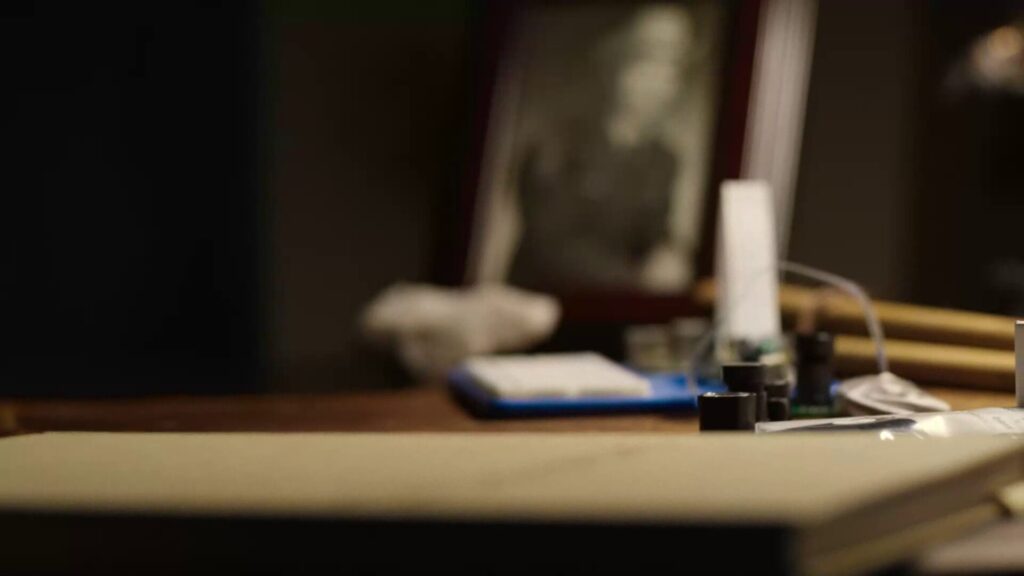
In Gold & Greed, Justin clearly shows that he is working with infrared. He even describes the project as essentially giving him x-ray vision. So when I see 42, I personally think of red, and red leads me back toward infrared and the project shrouded in mystery.
Having worked with that exact of board, those lights, and camera lenses, I am confident he is referring to red, and more specifically, infrared. Infrared light allows a camera to see in the dark when paired with a NoIR camera sensor, which is a camera sensor without the standard infrared-blocking filter. While infrared is commonly used as a light source in low-light or no-light settings, it can also reveal colors, materials, and surface details in ways the human eye cannot.
Getting back to how this relates to the hunt… Your guess is as good as mine. Justin may be just suggesting he is monitoring a location. I personally find it less palatable that a hunter must be able to use infrared to find the treasure. I lean more into the idea that Justin is providing a nod to something that only he needs to know but found it interesting and wanted to share. While the entry to see IR is low, it does require a tool. Albeit just your phone, but still a tool.
As I say in all my posts, anything I provide is subjective. It may or may not have a role in anything. It may sound like splitting hairs, but in a treasure hunt, splitting hairs is sometimes the whole game.
Other ideas for the meaning of the number 42 are out there. Some are very good and simpler. I have some other ideas that I will be sharing here in the near future. However, in this post, I wanted to provide something maybe you have not thought of.
Wonder guards this sacred space. The word red in sacred has always stood out to me. Maybe after you find the double arcs, it’s time to go infrared? Now I have to figure out how to do that with my iPhone. Great article, thanks.
Not to send you on a wild goose chase but there is a good way to test out the IR logic so you can understand the general concept. Just beware that it may not work. The conditions need to be right when it comes to the type of IR. The good news is that IR from things like a TV remote may work.
To give you a better chance, turn off the lights or go to a dark area with a TV remote and your phone. Open the camera app on your phone and point your camera at the front of the remote. Looking through your phone, and the camera close to the sensor of the remote, press a button on the remote. If the remote is using IR, there is a good change you will see a faint pink/red light blink.
What you are seeing is the IR light emitting from the remote that is not caught by the IR filter of the phone camera. This demonstrates on a small scale what you would see if you were using a camera lens without a filter on it.
There are a ton of videos on this. One of which can be seen at https://www.youtube.com/watch?v=U6MnASsdWUg.
To be clear, this does not mean you can see all IR light using your phone but it does show how it would look on a small scale.
Thank you!
Rainbow Point is how many turns past bakers hole campground? 42 is the missing answer to everything that isn’t possible to find.
Example: Moms House.
4,2,2,2,3,3,1,0,1,1,1,1
42+2=44+23+3=70
44.7042,-111.1014
Safe code in Netflix 42,26,11
42+2=44
44+26=70
70+11=81
44.7081,-111.1014 is gps coordinates across from spot 42 at bakers hole campground.
The best treasures, after all, often hide in plain sight – sometimes between the lines of an acknowledgments page. JG call me.
The Mirror Plateau…
Train drawing in the book 7670
Gannet peak on the website map 7076
If you also mirror his Ursa Minor dots, which aren’t exactly the same as the real Ursa Minor – then overlay them on the BHC arial view – the points match up to her face, her foot of three and the treasure location. Along with the start of the few trails to get to her. I believe.
You can also mirror the image where he’s standing north of BHC at the beginning of the book and it matches up to another location slightly south. I believe.
Nine mile hole treasure chest is on page XIII. BHC is 13 miles from nine mile hole? BHC is a named person place or thing that fits all of the rules.. And you can “sneak” into Yellowstone here, you know this already.
How many days after you posted the photo of you on the Maddie by BHC – Did just say someone has been within 200 feet of the checkpoint?
On page 42 of the book he’s on sled hill with Old Bump in the background? On page 68 he’s in the kitchen – notice professor pudge on the fridge – bent tree? The coon in the sink experiencing his first bubble bath. The coon with his hand in the cookie jar… there’s a lot to tell in that photo. But that’s representing BHC. I believe.
42+2=44
68+2=70
Check out page 118 where he’s fishing and the multiple 3s are in the background. Then go backwards to page 111 and check out that cropped 7 (photo of him and his bride) on there that takes us back to 118 (our next locational clue him fishing in rainbow troutville aka under the double arcs, the firemen returning her face – notice him looking back at you). Then we go to page 168 (Tucker on location) and 200 (the loot). 200/2=100+8-6-1=101.
-111.1014 (the 2 doesn’t fit to make 42)
44.7042,-111.1014 BHC
She’s just north of bakers hole campground. Check out her face – theres two of them? 😉
JH