August 2025
I started having second thoughts about what “waters’ silent flight” could mean.
My original interpretation had become so tangled in my own bias that I could barely see anything else. By that point, I had been physically BOTG for 15 days, but mentally, it felt like maybe a week. I had spent too much time circling the same ideas and staring at the same maps.
Something needed to change, but it had to change in a rational way.
I called a friend who was also BOTG in Montana. I wanted to run a new theory by him, mostly to hear myself say it out loud and see if it still made sense once it left my head.
I told him I was rethinking “waters’ silent flight.”
He was cautious. He reminded me that moving the target just for the sake of moving it could burn valuable time, especially while already on the ground. He was right, of course. Chasing a new idea in the middle of a trip can be dangerous. One wrong turn in logic can cost a full day, sometimes more.
But, like a good friend, he listened anyway.
“What if silent flight means the water is leaving something?” I said. “Maybe fleeing from something. Maybe crossing some kind of boundary.”
The idea was never very high on my list of possibilities. It felt more like a loose thread than a solid lead. Still, I had already accomplished the main goals of my BOTG trip, and I had time left to explore a different perspective.
I continued explaining the thought process. In The Curious Confluence, Justin ran into Forrest Fenn and had a conversation that seemed to give him a renewed sense of adventure. After that talk, Justin mentioned an internal debate about where to search next. Those places clearly meant something to him. They may have even been important enough to change the course he had already charted for his trip.
Where would I search next? The Gallatin River? The Grand Tetons? Or perhaps somewhere closer, near Taos Pueblo or Ojo Caliente?
Like Justin, I started thinking about those places as well. A little irrational, perhaps, but there was something in the calling. Something that makes you think differently and shoot into the dark with hope as your guide.
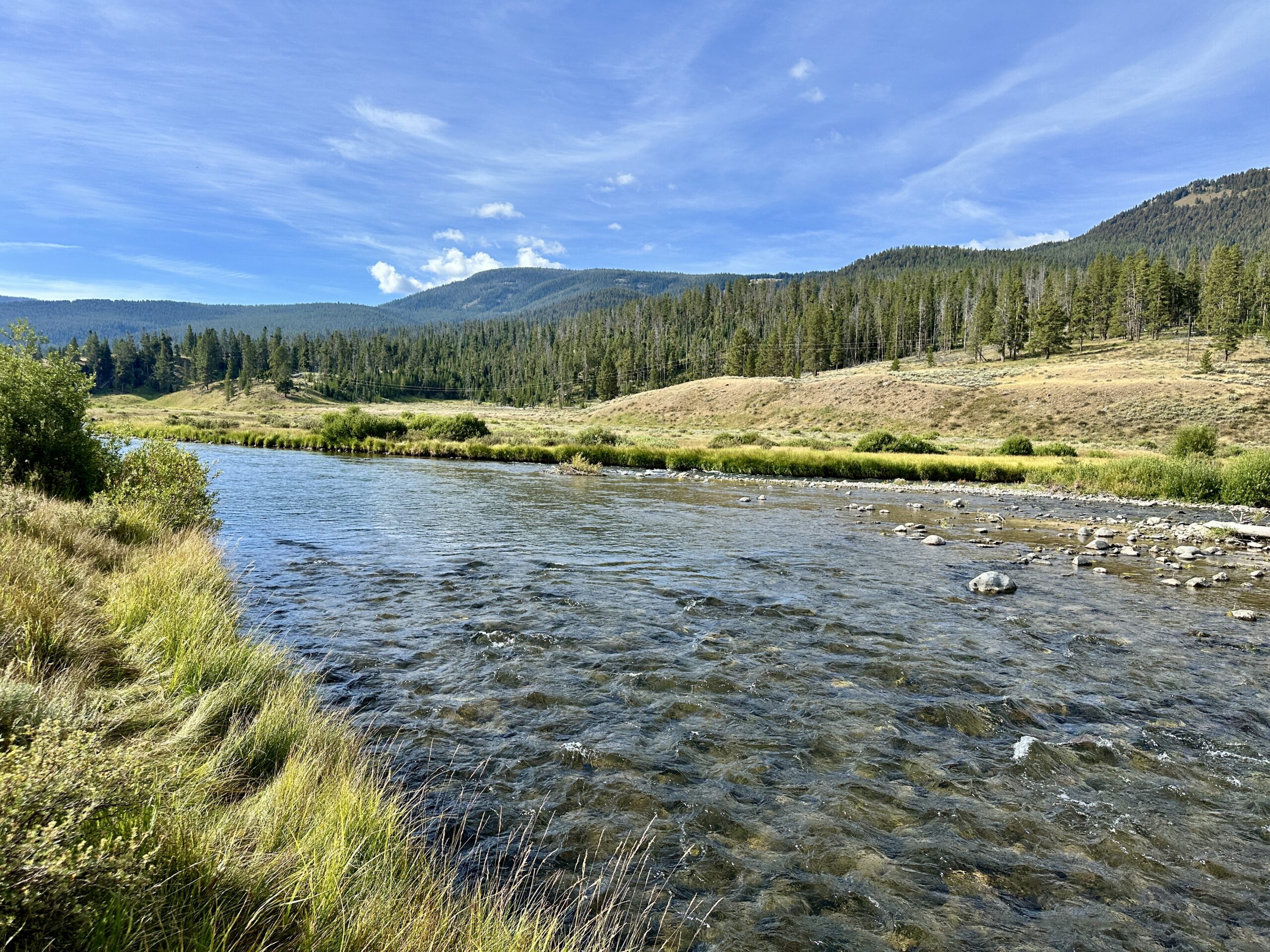
At the time, my basecamp was in the Greater Yellowstone area, and two of those possible locations were within a reasonable drive. Sitting in the front seat with maps spread across my lap, I traced the Gallatin River north along Highway 191. My finger followed the river as it slipped through the landscape, winding out of Yellowstone National Park and into the Gallatin National Forest.
Highway 191 is one of those routes that flirts with the borders of Yellowstone. It bends in and out of the park boundary and can be traveled without paying to enter the park. Near the border, there is a pullout, a sign, and popular fishing access along the Gallatin. I had passed through that area before, but I had never given it much thought as a solve area.
When I arrived at the pullout, I stepped out of the truck and immediately started walking the river’s edge downstream. The Gallatin moved beside me, not in silence exactly, but I needed to stick to the script.
I stopped along the bank and opened the maps I had collected. I studied the property boundaries, nearby trails, creeks, access points, and the names printed across the terrain.
To the north were Tepee Creek Trailhead, Sunshine Point, and Taylor Creek. Farther north and northeast was the Hyalite-Porcupine-Buffalo Horn Wilderness Study Area. To the south, across the river, was the Lee Metcalf Wilderness.
The more I looked, the more the location began to feel like a place of transition. Park to forest. Road to river. Public access to wilderness. Water crossing boundaries.
Many mental boxes were being checked, but I needed a plan. I walked back to the truck to make some dinner and figure out what I was going to do next. I pulled into a nearby dispersed camping location off Taylor Fork, and that is where I stayed for the night.
The next morning, I wanted to be on foot before the sun came up. I wanted to see how the sunrise projected itself across the mountain range around me. Once I finished my cup of coffee, I drove back to the pullout at the Yellowstone National Park border, sat on my tailgate, and watched the sun rise over the mountains.
If this location was “silent flight,” I needed to start walking.
I decided to walk north because crossing into Yellowstone required payment.
As I walked, I decided to take the other side of the road. If I was going to find anything here, it probably would not be on the side where people parked, walked, fished, or posed for pictures with the sign.
A few minutes into the walk, I noticed the sun casting light beneath a pine tree about 200 feet from the pullout. There was a box of sorts tucked under the limbs. I hiked the short distance over to it and found a birdhouse.
There was nothing indicating it was part of a federal or local project. In fact, the only marking was a brand burned into the face of the birdhouse: a sideways S encased in a circle. Clearly, this was a personal project of some kind.
As a curious but responsible outdoorsman, I can only imagine what the bird inside saw as I cautiously checked the opening. Knowing not to touch or disturb anything that might be inside, I still could not help myself. I leaned closer and closer, trying to see into the darkness.
As the shadows inside began to lighten and my eyes adjusted, I was suddenly blinded by flying debris, followed by what I can only describe as an old man yelling at me to get off his lawn, but in bird language.
I backed away from the birdhouse with my hands up and one eye closed, as if the tiny creature would understand that I was compliant and submitting to its verbal commands.
I think it is important to mention that while I did not touch or disturb anything, at least in my eyes, the bird inside clearly did not appreciate my childish “but I’m not touching you” approach.
Eventually, the bird showed itself in the opening of the birdhouse. I am not sure what kind it was, but it could not have been more than inch or so tall.
I honestly debated putting a new sign below the birdhouse for anyone else who might pass by.
“Stay Away! Cute But Dangerous Bird Inside.”
I continued walking north and noticed more birdhouses along the way. Wisely, I decided to keep my distance as I traveled.
Eventually, I made it to the Tepee Creek Trailhead. There, I noticed a sign stating that the land was closed to all access during certain parts of the year. This immediately weakened my theory about this side of the road. The wilderness area here was protected during parts of the year and was not open to traffic during those periods.
As I hiked back to the truck, I decided to call it a day, find a new basecamp, and be an adult by getting some work done.
Unfortunately, I never returned to the area. Since that day, I have wondered how many other travelers that poor bird has had to deal with.
While this story is not a complete solve, I do feel like I can share my notes from the area in case anyone else wants to try their luck.
Notes
The Yellowstone National Park sign is directly aligned 20 degrees off north and has three support feet.
The sign itself may be worth considering as a possible gate.
If you return to the other side of the sign, it reads “Gallatin National Forest.” This made me wonder if “return her face” could mean returning to the opposite face of the sign to find the place.
The area across the river is National Forest land.
The National Forest tucks back into Yellowstone in this area, making it an interesting hiding spot. Whether it makes the right hiding spot is another question.
While this location now carries its own personal lore for me, I still think the area deserves another look through the lens of Justin’s clues.
Whether or not the treasure ever passed through this theory, I left the area with one confirmed discovery: not all guardians are large, and some of them live in birdhouses.
While I didn’t encounter any anger my birds, I’ve driven and walked this more times than I care to admit trying to see if anything fit. It’s not my original area but my daughter moved just up the road to the N of there from Mi. It’s such a beautiful area. We did see a momma moose with new twin calves on the west side where the river crossing. I find the area as intriguing as you. I very much appreciate your writing style 🙂
Thanks for reading.
191 coming into YNP and West Yellowstone is one wild ride and a beautiful scene for sure.