This post is one I debated on writing not because it is far off in left field but because every keystroke is a personal reminder. I would be pointing out someone else’s missed calculations when I had my own to deal with. However, it has been an important piece of the puzzle relating to my solve and maybe that is what Justin wants us to know.
There are three sections of the book that stand apart to me: “Prologue,” “The Treasure Trail,” and “The Probability Paradox.” They appear as separate stories, divided by episodes from Justin’s life, but they are really parts of one continuous narrative.
Together, they tell the story of Brandon meeting Justin for what would be their final search for Forrest Fenn’s treasure together. They meet in West Yellowstone and make their way into Yellowstone National Park, following years of theories, maps, evidence, and instinct. Beneath the details of the search, these sections create a portrait of the last time Brandon and Justin were together hunting for the treasure.
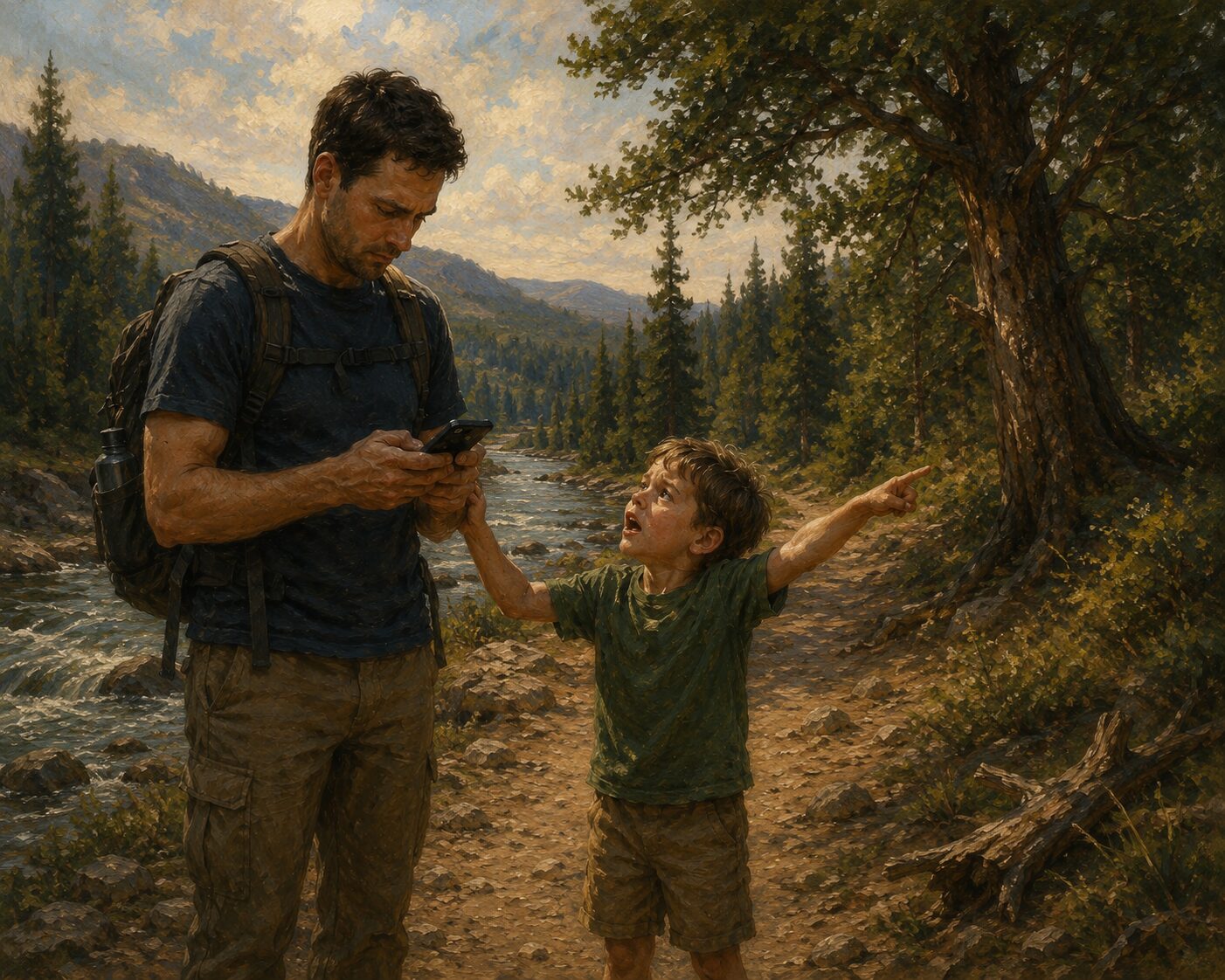
The stories also seem to contain the subtle outline of a localized road map. Yet their deeper meaning is not simply about where Justin and Brandon traveled and what they were doing there. They reveal how Justin had missed what mattered most because he was looking down—absorbed in technology, theories, probabilities, and the promise of gold—rather than being in the moment.
This idea is strongest in “The Probability Paradox.” Even the title suggests a contradiction: Justin relies on systems, calculations, and possible solutions to determine where he should go, but his dependence on those tools prevents him from recognizing where he truly is. He is so consumed with solving the search that he fails to see the value of where the journey led him.
In this passage from “The Treasure Trail,” Justin briefly steps outside the story and speaks directly to the reader:
“Yet before boots hit dirt, before GPS marks first coordinates, there’s always this: a kitchen table, midnight oil burning, maps spread like battle plans, and Forrest’s poem staring back at you.”
I interpret this as Justin telling us that the solving belongs at home. Study the clues, build theories, examine maps, and plan the journey as carefully as possible—but leave that work at the kitchen table.
Once your boots hit the ground, the search should become something different. The theories may lead you to the place, but they should not prevent you from experiencing it. Put away the maps, look up from the GPS, and be present in the moment.
Seen this way, the passage carries a quiet warning. Justin understood how to prepare for the hunt, but he did not understand when to stop solving. He became so focused on locating the treasure that he overlooked the experience already unfolding around him. The tools were meant to guide him into the moment, not replace it.
This idea is supported later in The Probability Paradox when Brandon is sitting on a downed tree, taking in the moment as Justin is buried is his solve and technology. Brandon points out a child learning to fish on the bank.
When Brandon says, “I bet he doesn’t have statistical analysis to back up his casting technique,” the remark sounds playful, but it may also be a confrontation. Brandon is telling Justin, indirectly, to stop calculating and return to the moment. The child does not need data to justify every movement. He simply casts.
Brandon may have been trying to create that same kind of space for Justin. I suspect he wanted to talk about something important, but Justin was moving full steam ahead, too consumed by the hunt to notice. Brandon’s humor becomes a gentle attempt to interrupt Justin’s momentum—to pull him away from the theories, the probabilities, and the next destination long enough for a real conversation to begin.
That possibility gives Brandon’s question—“You okay up there?”—a deeper meaning. On the surface, he is checking on Justin. But Justin responds with the same familiar redirect he has used throughout his life, turning attention back toward the task in front of him.
The painful reversal is that Justin should have been the one asking the question.
He was so accustomed to being the person with the plan, the map, and the answer that he missed the signs coming from Brandon. Brandon may have been asking, without saying it directly, to be noticed. Justin heard the words, but not the need behind them.
In hindsight, “You okay up there?” becomes almost an accusation directed back at Justin. He was looking ahead, looking down at the technology, and looking for treasure. The question he answered may have been the question he failed to ask.
If you have read the book, you are probably shouting that you already know this. This post is not meant to tell you something new. It is meant to remind you as well as me, to be present when we are out there.
See the kid fishing. Notice and acknowledge the sounds around you. Leave the solves and the technology where they belong once they have shown you the way.
Otherwise, you may become so focused on finding what brought you there that you miss why you came. This guidance and these stories should live in your mind when you are BOTG.