Forgive my nerd joke as the title. I could not help myself. It has been in my head ever since the Seekers Summit Q&A in Tucson, Arizona was published online.
For me, the map in the book and on the website is the most underused asset in the hunt. We all know it is there, and many of us have theories about what it might reveal. There is one particularly interesting suggestion regarding it. Jenny Kile touches on the idea.
Still, compelling is not the same as confident. It reminds me of the Rorschach inkblot test a therapist administers. I would love to talk more about it, but this blog post is about a theory I have.
Before you continue reading, keep in mind that this is a working theory. It is incomplete, and I am still actively exploring it.
I usually look for repeatable patterns, verifiable tests, and solutions that resolve cleanly to zero. This theory does none of those things, at least not yet.
Read it for what it is: an unfinished attempt to understand an idea that may still change shape, or, vanish into thin air.
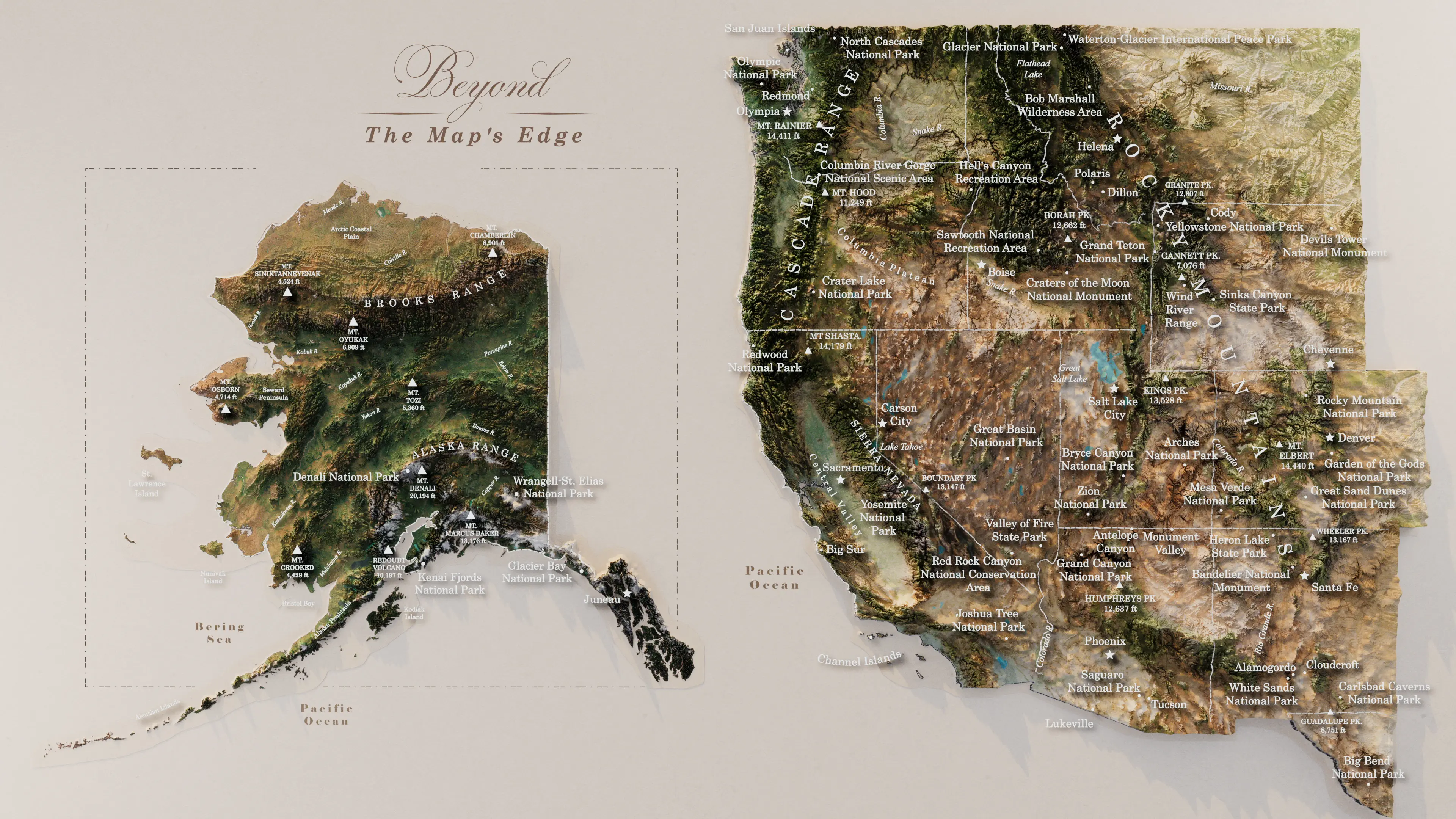
During the Q&A session at Seekers Summit, Justin was asked whether the map remains useful after a searcher has made tangible progress, or whether it is most useful at the beginning of the hunt.
“I think it is a good primer,” he replied.
Source: Seekers Summit Q&A, beginning at approximately 1:18:19.
To me, that response suggests the map is primarily meant to orient searchers at the beginning. Calling it a primer makes sense. If I am handed a poem and a map like this one, my initial thought is: Use the map first to narrow down a starting location to a smaller region.
A primer introduces the subject; it does not finish the lesson. The map, in this theory, is intended to establish the search area, and provide a starting framework.
The question we all seek is, how.
Like everyone else, I have spent hours of my life looking at the map, putting locations in alphabetical order, elevations in order from lowest to highest, and even tried to align the map with stars in the sky. Connecting the dots is a recurring theme when I pull out the map. Hell, I even tried Cluster Analysis on the intersecting points of all possible lines.
At every turn, I have failed to identify a concrete connection.
The “good primer” response from Justin, lives rent free in my head. Then, I had one of those middle of the night, bright ideas that can wake you up from a deep sleep.
Most of my experience with prime numbers comes from encryption and public/private key cryptography.
In systems such as RSA, two large prime numbers are multiplied together to produce a modulus (a mod). Multiplying them is easy. Starting with the resulting number and determining which two primes produced it is enormously difficult once the numbers become large enough.
For a 2,048-bit RSA key, the mod is typically built from two primes of roughly 1,024 bits each. That asymmetry, easy to calculate in one direction, brutally difficult to reverse, is part of the foundation of secure digital communication.
I have little doubt that Justin understands the basics of cryptography. He is, after all, the CEO of LayerV.
My own study of number theory is limited, but the idea seems prime for a treasure hunt. Pun fully intended.
Which brings me back to that phrase:
“A Good primer.”
Was Justin simply saying that the material provides a useful introduction? Or was “primer” chosen because it quietly points toward primes?
What if Justin is hinting at the idea of a “good prime” number?
A good prime is a prime number whose square is greater than the product of every matching pair of primes equally spaced on either side of it.
Good primes belong mainly to pure number theory and really have no known practical application. Think of them as the mathematical equivalent of a yo-yo player performing “Walk the Dog”: an elegant act whose main purpose is to reveal what the object can do. Their interest lies not in their usefulness, but in what they tell us about the hidden structure of prime numbers.
Source: https://en.wikipedia.org/wiki/Good_prime
Thinking about how to apply good primes to the map, I ended up finding a plausible answer in the things not on the map.
Each state on the map is a territory that belongs to the United States and each state has a number, a label silently assigned to them that represents statehood admission order. Probably more meaningful to the early colonists than it is today, but meaningful nonetheless in the grand scheme of history.
Take all 50 states and write down the order they joined our great experiment. Then subtract all states that are not good primes. The states left that really matter are: 5, 11, 17, 29, 37, and 41.
- Connecticut = 5
- New York = 11
- Ohio = 17
- Iowa = 29
- Nebraska = 37
- Montana = 41
If we remove the states that are not located in the search area (displayed on the map), the theory is left with one state.
MONTANA
Now we have something interesting.
However, this means nothing other than a coincidence without a way to test against it. I admit, it is a good card trick, but it is still a trick until proven.
So if the theory uses the “good primer” hint, how can I test against it using what the map always had?
The Staged Dilemma and a Sub Theory
I write this section as an afterthought, weeks after spending countless nights searching for a test that might give this theory ground to stand on. So far, I have reached only one conclusion, and yet another question.
Did Justin intentionally give us a map that would remain silent, serving mostly as a placeholder, until being called upon?
In an early interview with Froggy of Este’s Quest, Justin explained that the hunt was designed to unfold in stages. If that statement was more than a general description, then perhaps the map was never meant to reveal all its secrets at once. Its apparent silence may not have been a flaw or an oversight. It may have been part of the design.
Since that interview, I have understood Justin’s use of the word “stages” to mean a series of linear phases. In this interpretation, the hunt’s progression was planned in advance through an algorithmic model based on the probability that someone would find the treasure over time as additional clues were released.
This new interpretation gained credence with me when Justin later published the logic behind the timing of the clock cipher. His appendix describes a probabilistic model used to explain the odds of a searcher being primed, given the number of total searchers, clues available, and the amount of time a searcher plays the game.
Source: https://treasure.quest/en/cipher-timing/appendix/
Under this possibility, a clue could remain visible, complete in nature, but not compatible with certain stages… Yet. It would already be present in the hunt, yet lack the piece required to make it useful. A timepiece could therefore do more than measure the hunt’s progress. It could control the progress, an intruder placed within the puzzle, something governed by time and nearly meaningless until the proper signal arrived.
This does not mean searchers are incapable of making educated guesses or stumbling into later sections ahead of schedule. Justin has suggested that the hunt was designed so that someone might occasionally advance in precisely that way.
But stumbling forward carries a cost.
When you skip a section, the ground beneath you is less familiar than it would have been, had you understood the path that led there. You may gain progress, but lose confidence in what that progress means. In a hunt where interpretation depends on balance, stumbling becomes a trade: distance in exchange for certainty.
Supporting Evidence
Justin appears to hold a deep respect for the history of the United States and a deep understanding of the process by which the country established its identity.
The Oak Shilling and its historical associations point in that direction. The coin was minted partly as a symbol of economic independence from England. It is the fruit of seeds that were planted at ground zero. Interestingly, the 1652 date was not when most were minted. The mint date was a loophole used to not offend the King and the law abroad, while still minting the currency.
Interesting Fact: King Charles II called the colonists a “parcel of honest dogs.” in response to the currency…
Another telling piece of evidence is The Declaration of Independence being displayed prominently beneath a light on his wall in the Gold & Greed series. Having the Declaration of Independence hanging on your wall is not just for looks. It is a statement that says, “I have not forgotten,” and suggests Justin has deep knowledge of the motives and sacrifices in the name of independence.
It might be the show prop from National Treasure now that I am thinking about it. Either way, the idea stands.
They represent the story of “US”. Now, all we have to do is listen.
Conclusion
Before I even get to the conclusion, you may already be punching your screen, calling me an idiot because you know the starting location is in New Mexico, or some other state, or nodding with an “I knew it” expression. Hell, this theory may even make you block me on social media.
Whatever you think of it, remember that it is only a theory. More specifically, it is a suggestion about where to start. I would genuinely love for someone to prove it right or wrong.
I debated sharing this because it is outside my usual approach. I normally prefer to present a theory with at least one verifiable test attached to it. This one does not quite have that yet. Still, I think there is room to play with the idea, and I know there are holes waiting to be poked in it.
For example, during the Dillon Q&A, Justin also says the show is a good primer. How do you apply this same logic to the show and reach the same result?
Honestly, I do not know. I have not looked at the show through this lens yet, which is one reason I have reservations about posting the theory at all.
But if this sounds like fun, play with it. Run with it.
I ask only one thing: if you find anything related to the starting region, share it publicly with the community so everyone can examine it.
Happy hunting. 🙂
Justin, your theory that “good prime” numbers are used as clues in this hunt presents a curious confluence of ideas. While it’s possible your interpretation is correct, it’s also possible that “good primer” simply means setting the stage or starting the path. I don’t think we have enough evidence yet to assume one way or the other. However, endlessly waiting for hard evidence can lead a treasure hunter to their demise. I’m reminded of World War Z, where Brad Pitt’s character saved humanity from a zombie apocalypse simply through observation and deduction (noticing that zombies weren’t interested in chewing on terminally sick people). Thus, mere intuition likely plays a part in this hunt, where outside the box thinking can lead to the ultimate solution.
I personally hope your interpretation is correct, as I’ve been following a path that leads to a labyrinth of prime numbers that seem to defy mathematical probabilities. Is it a clue? Not sure, but I intend to investigate my target area next week (once I finish recuperating from a strenuous Montana backcountry hike I foolishly tackled last weekend in search of fortune and glory). Keep up the good work, and good luck out there!
Hey Justin, enjoying your blog! I will tempt you with a good prime (🥁 ba da ching) in Aft Assault speaking about grasshopper valley he uses 2 good primes in describing it – “Our family friends, ranchers who could probably teach you 17 ways to mend a fence and another 5 ways to repurpose a rusty horseshoe, have been anchors in that valley for as long as I can remember.” Just thought I’d burden you with some confirmation bias! 😂